For Nonprofits Blog
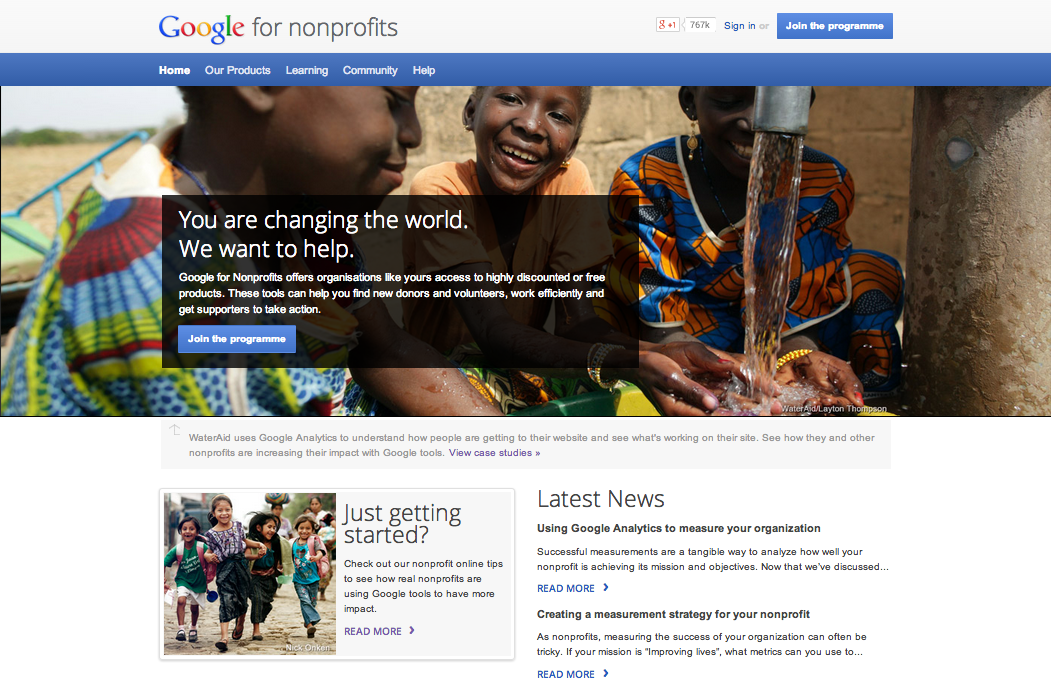
You're changing the world. We want to help.
We’ve revamped our YouTube Channel!
Monday, October 27, 2014
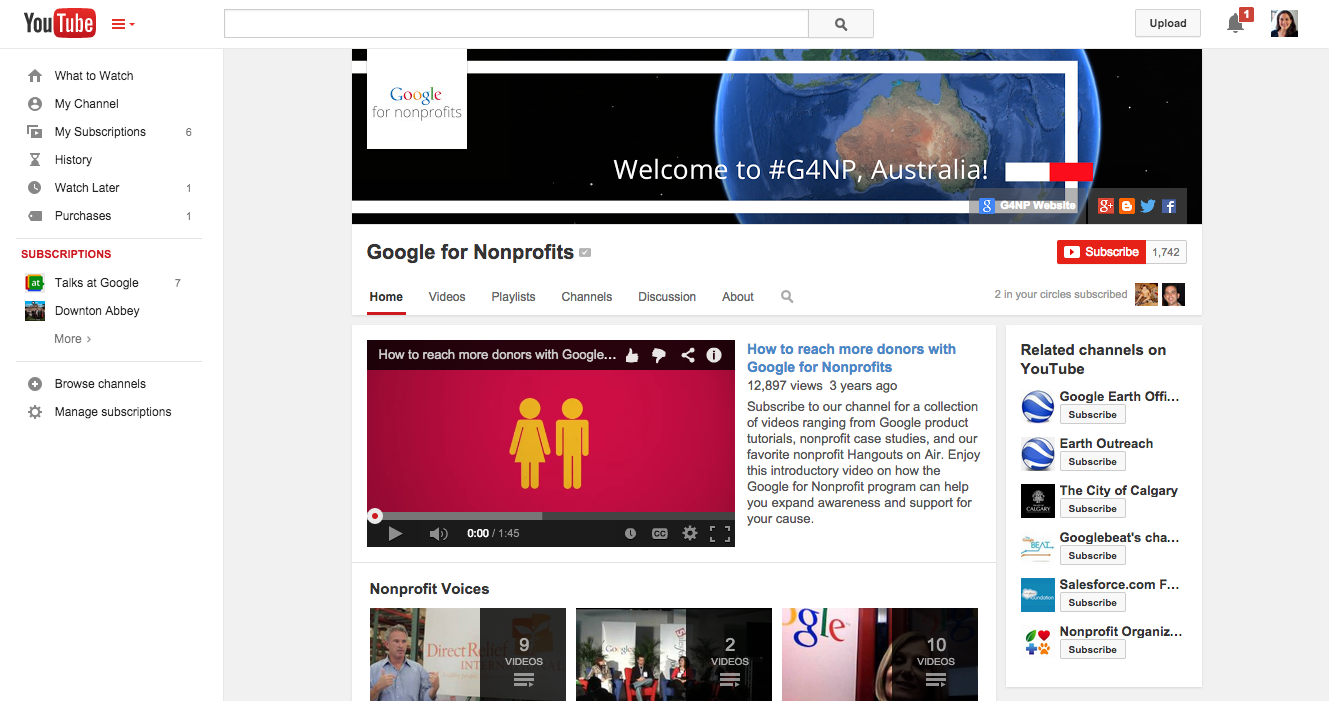
Check out the Top 3 Tips from our #G4NP Channel Refresh
If you’ve ever visited the Google for Nonprofits YouTube channel before, maybe it’s time to take a second look. Over the summer we re-launched our channel to optimize it for our audience - you! To transform the Google for Nonprofits channel, we thought long and hard about the needs of our nonprofit users, and followed several of the basic guidelines from the
Creator Academy Handbook
.
Below, check out our Top 3 Tips from the #G4NP YouTube Refresh:
A Better First Impression
What we did: We updated the first impression of our landing page by adding a trailer video, added compelling channel art and added social media links.
Tip: Use channel art that is relevant and captivating to help tell your story, demonstrate impact or feature an anthem video, for example. Remember, it takes less than two-tenths of a second for an online visitor to form a first opinion of your brand (source:
http://www.entrepreneur.com/blog/223150
).
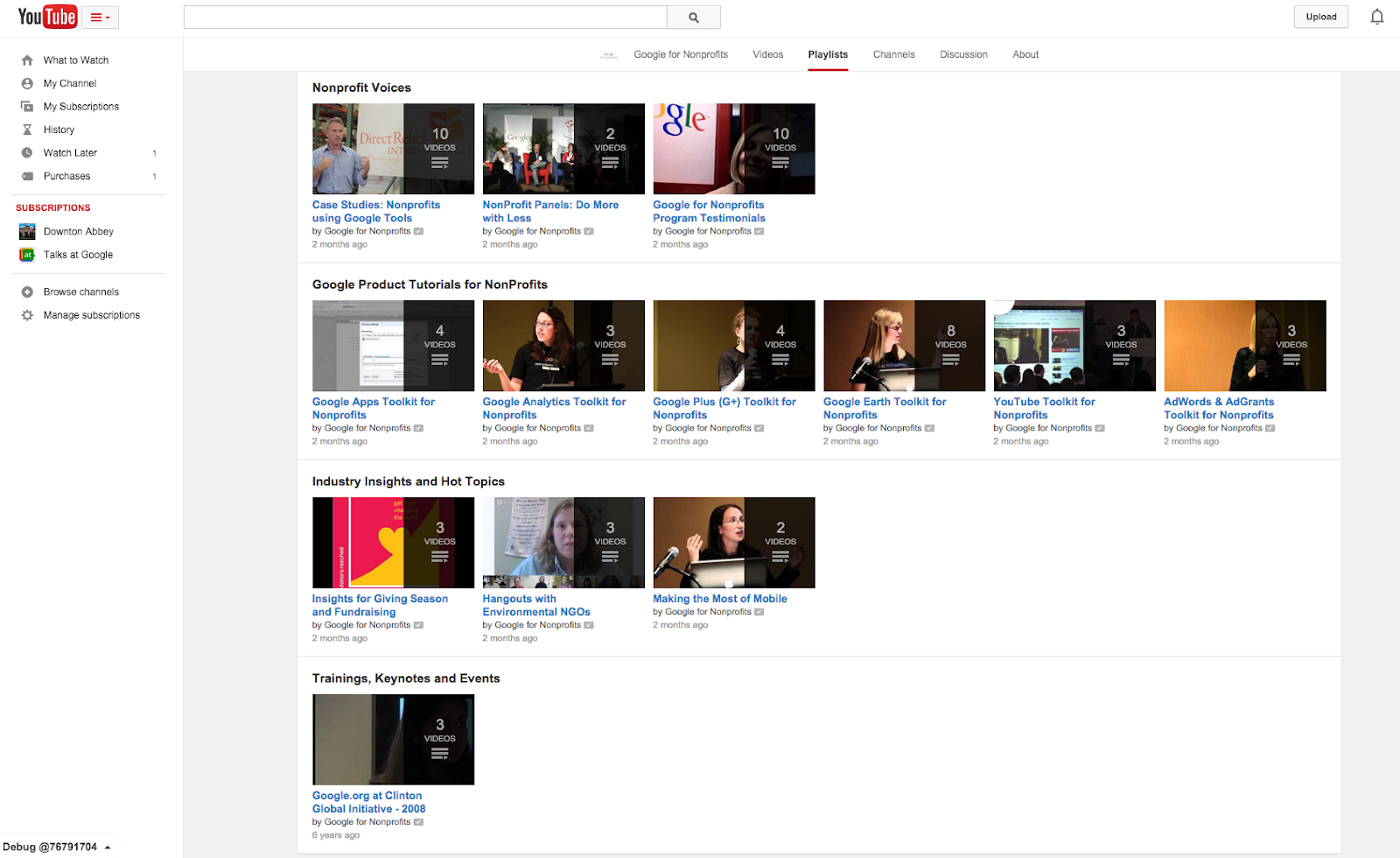
Playlist & Sections
What we did: We took a close look at all of the content that was currently on the channel, as well as what has been the most impactful to our audience, and we discovered that themes emerged. We then created sections and Playlists based on these learnings that we were able to apply across the channel. (
Nonprofit Voices
,
Google Product Tutorials
,
Industry Insights and Hot Topics
and
Trainings Keynotes and Events
)
Tip: Take a look at the content on your channel and see if there are any themes or similar threads that arise. Creating sections can help consumers find content quicker, which will give them more time to watch your content.
Optimized Titles and Thumbnails
What we did: We cleaned up the raw content on our channel, updated the titles to be consistent in formatting and wording, and ensured the thumbnails gave a glimpse into what the full video was about. For example, in this series of videos,
Case Studies: Nonprofits using Google Tools
, we edited to ensure that the faces of the nonprofit leaders were featured prominently.
Tip: Tease out the story that your videos tell through the title, thumbnail and description. Think of these pieces, collectively, as your content’s billboard. A compelling video billboard can be the hook that attracts new fans who are looking for great videos and channels on YouTube. Check out a good example,
here
.
Our team continues to work on more advanced YouTube optimizations that we hope will make the content more accessible and relevant to our users. As we continue to learn and iterate, we will share best practices with our community so that you can take some of the learnings and implement on your own channels.
To learn more about YouTube Creator Academy, click
here
.
Introducing Skybox for Good
Friday, October 24, 2014
With
Skybox
joining Google we have a tremendous opportunity to leverage our imaging satellites for positive change in the world. Yesterday, at our annual
Geo for Good User Summit
, we announced the Skybox for Good program, under which we will contribute fresh satellite imagery to projects that save lives, protect the environment, promote education, and positively impact humanity.
We’ve already begun supporting projects such as this, and we wanted to share some of the results. We have been monitoring sites critical to our understanding of global climate change, such as the Helheim Glacier in Greenland.
18 August, 2014 | Helheim Glacier, Greenland | SkySat-1
The
Harvard Humanitarian Initiative’s Signal Program
has been using our imagery to help develop tools for
Internally Displaced Persons
camp management in Africa and the Middle East.
16 March 2014 - Yida, South Sudan - SkySat-1
Access to global satellite imagery through Google Earth and Maps has changed the way people see their world - from the cities they live in to faraway places. On the
Google Earth Outreach
team, we have witnessed the way these tools have changed how
our partners
do their work and tell their amazing stories.
We’ve captured some images of Nagarkovil village in Northern Sri Lanka.
HALO Trust
previously cleared landmines in this area and used updated imagery to help verify that people are returning, having built 84 houses and cultivating over 40 hectares of agricultural land.
3 October, 2014 - Nagarkovil, Sri Lanka - SkySat-1
View
full image
in Google Maps
In this beta phase of the program, we will select a small group of organizations and provide the imagery they need to accelerate their work. The images collected for these partners are being made available publicly, under a Creative Commons By Attribution license (
CC BY 4.0
), for everyone to see and use. We’ve already started collecting a few images, which you can see on
this map
. Check out the images in West Virginia, where
SkyTruth
and
Appalachian Voices
are monitoring and measuring the rapid expansion of mountaintop-removal (
MTR
) mining which is devastating forests and communities across Appalachia, visible in the image below, right next to the popular hiking trails of Kanawha State Forest.
M October, 2014 - KD-2 Mine, West Virginia - SkySat-2
View
full image
in Google Maps
Google Earth Outreach gives nonprofits and public benefit organizations the knowledge and resources they need to visualize their cause and tell their story.
In the future, we hope to expand the Skybox for Good program to allow many more non-profit organizations and public interest groups to benefit from the use of Skybox data.
For more details visit the
Skybox blog
.
Follow us
@earthoutreach
for updates as we expand the program.
Posted by Julian Mann, Skybox co-founder & Developer Advocate, Google Earth Outreach
Google for Nonprofits Goes Down Under
Monday, October 13, 2014
Over the past few months, we’ve been overwhelmed by the incredible energy and excitement of the Australian charities who have participated in the
Google Impact Challenge
. On issues ranging from ecological preservation, to homelessness, sanitation and solar power, Australian charities are proving that digital tools can have a transformative effect on an issue.
That’s why today, we’re excited to take our commitment one step further by launching
Google for Nonprofits
in Australia.
Australian Charities and Not-for-Profits can now
apply to join the program
, which provides access to a suite of free products and tools, including:
Google Apps
provides a range of enterprise tools -- from email to Google Docs -- that reduce technology costs and encourage collaboration.
Ad Grants
provides a $10,000 grant for nonprofits to raise awareness and target new audiences online.
YouTube for Nonprofits
and
Google Earth Outreach
provide rich opportunities for nonprofits to create interactive content and visualize their impact.
Australia has 60,000 charitable institutions, and many of them are already using Google tools. For example,
The Australian Wildlife Conservancy
(AWC) is using Google Earth Pro’s 3D mapping technology to demonstrate their impact to donors, community members, and a global audience.
With twenty-three wildlife sanctuaries across Australia, AWC protects more native Australian animal species than any other non-government organization. Using Google Earth Pro, AWC is now able to take
their supporters on a virtual “tour” of their sanctuaries around Australia and provide a broad overview of the scale and diversity of the wildlife and habitats they protect.
Check out our
case studies
learn how AWC and other Australian NGOs are using Google for Nonprofits, and
join the program
.
Google for Nonprofits launches in New Zealand
Wednesday, August 27, 2014
For most Kiwi charities, the web is becoming a vital platform for improving visibility, raising awareness, and connecting with donors and volunteers. The big challenge, though, is how to make the most of this technology when there are so many competing demands for funding and resources.
That’s why we’re so pleased to be making
Google for Nonprofits
available here in New Zealand. Starting today, eligible community and voluntary organisations in NZ will now have free access to online marketing and technology from Google worth more than $120,000 each a year.
What’s in the package? Eligible charities will receive:
Up to USD $10,000 of Google AdWords each month, so they can get their site in front of people who are searching for services like theirs.
Free use of Google Apps, so they can run their email and important documents in the cloud and work collaboratively on documents while dramatically reducing IT costs
Google Earth Outreach, a free license for the pro version of Google Earth so they can visualize their data in map version online
YouTube for Nonprofits, so they can make great campaigns that catch the eye of donors and supporters
Last night, we officially launched Google for Nonprofits in New Zealand at the Mental Health Foundation. Various NGOs that are already leveraging some of Google's tools attended and shared best practices and insights into how best to use these tools. One presenter, Judi Clements, CEO of the Mental Health Foundation spoke about how Ad Words delivered a 25% increase in traffic to their website, the largest increase in traffic they have ever experienced.
We want Kiwi charities to be as connected and collaborative as possible, so they can continue to do their great work changing the world. With Google for Nonprofits, they can have the same web tools as much larger, better resourced organisations, so they can do their great work more easily.
Posted by Ross Young, Public Policy Manager, Google New Zealand, Cross-posted from the
Google New Zealand Blog
Inspire kids to create our future: Apply for a 2015 RISE Award
Monday, August 18, 2014
Technology has the power to change the world for the better, but today far too few have access to the education or encouragement they need to become creators, not just consumers.
We know
that pre-university exposure to Computer Science education is critically important for inspiring kids to pursue a career in computing.
That’s why Google offers the
RISE Awards
-- grants of $15,000 to $50,000 USD -- to organizations across the globe working to promote access to Computer Science education for girls and underrepresented minorities. Our RISE partners are changemakers: they engage, educate, and excite students about computing through extracurricular outreach. In 2014, 42 organizations
received
RISE Awards—with projects ranging from coding clubs in Europe to web development camps in Sub-Saharan Africa. In April, we brought all of our partners together for a Global Summit that sparked resource sharing and collaboration amongst organizations.
We’re looking for more partners in 2015.
Submit
your application by September 30, 2014 in English, French, Japanese, Russian or Spanish. All eligibility information is listed on our
website
.
Posted by Roxana Shirkhoda, K12/Pre-University Education Outreach
Google for Nonprofits launches in Japan
Wednesday, July 9, 2014
Japan has a growing and increasingly impactful nonprofit community—a 1998 NPO law invigorated the sector, and gave rise to the incorporation of more than 49,000 new organizations. Nonprofits like these are doing critical work for people in need, including recovery efforts for the 2011 Tohoku earthquake, and we want to do more to support them. That’s why today, we’re excited to collaborate with TechSoup Global to bring
Google for Nonprofits
to Japan.
Specified Nonprofit Corporations, Public Interest Corporations, and Social Welfare Corporations can now
apply to join the program
, which provides access to a suite of free products and tools, including:
Ad Grants
provides a $10,000 grant for nonprofits to raise awareness and target new audiences online.
YouTube for Nonprofits
and
Google Earth Outreach
provide rich opportunities for nonprofits to create interactive content and visualize their impact.
Google Apps
provides a range of enterprise tools -- from email to Google Docs -- that reduce technology costs and encourage collab
oration.
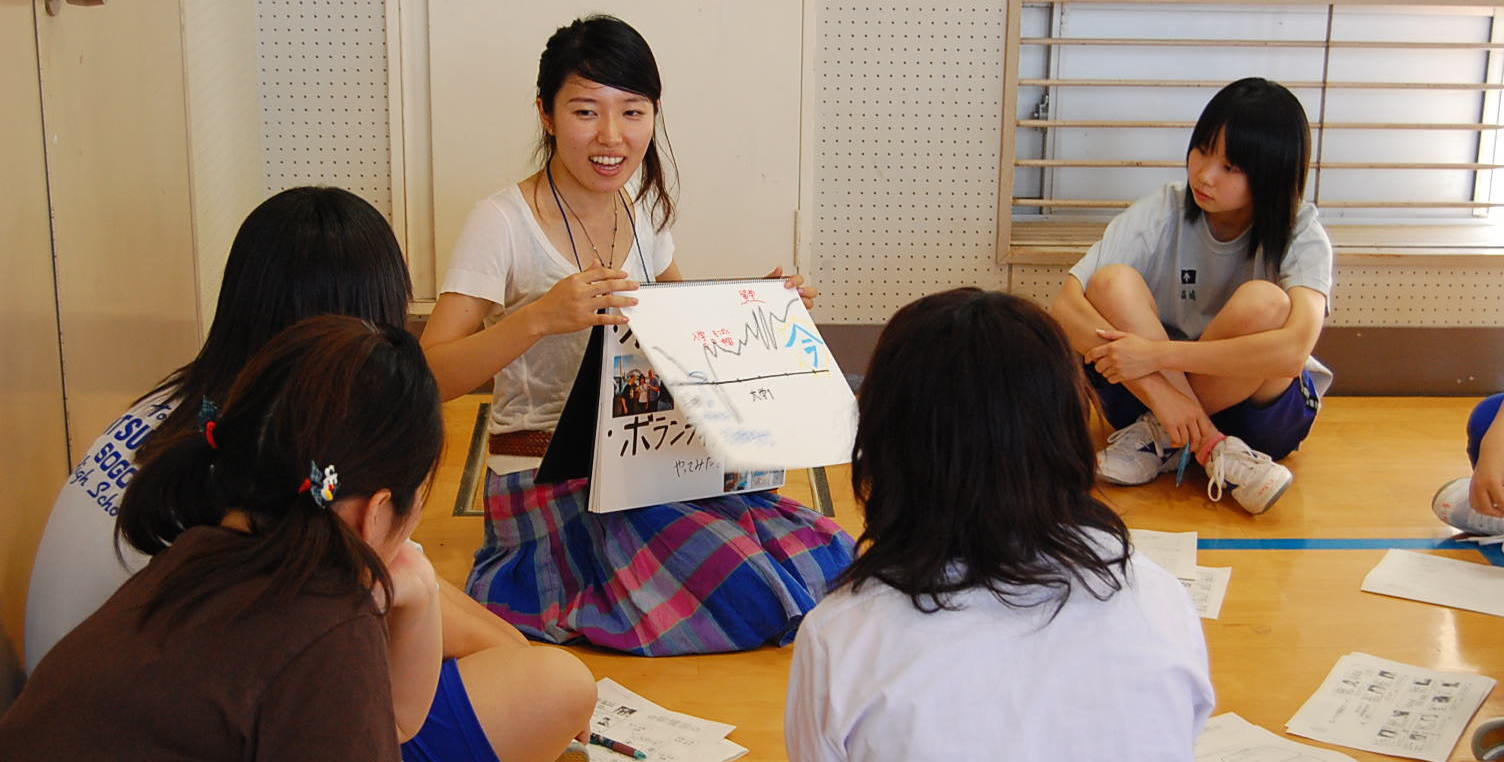
We’re big believers in the Internet’s ability to help nonprofit organizations find new donors and volunteers, as well as become more efficient in their work. Japanese NPO Katariba, for example, is an volunteer-led organization that provides career education and counseling for high-school students.
Photo from
NPO法人カタリバ
| NPO Katariba, an organization using Google for Nonprofits.
Before joining Google for Nonprofits, Katariba’s volunteer recruitment process was labor intensive for staff, and outreach required a large portion of their PR budget. Now, Katariba saves time and money by using their $10,000 per month Ad Grant to reach people who are already searching for “NPO job” or “education volunteer” on Google. Since joining the program, the organization has seen 35,000 new site visitors.
We’re inspired by Katariba’s story and the amazing ways so many more nonprofits are using technology to aid their cause. We’re looking forward to supporting the work of more nonprofits in Japan.
Visit
Google for Nonprofits
to learn more about the tools and
join the program
.
Posted by Naveen Viswanatha, Product Manager, Google for Nonprofits
You're changing the world. We want to help.
Monday, June 9, 2014
Today, we are excited to work with TechSoup Global and TechSoup Canada to bring Google for Nonprofits to Canada.
Canadian Registered Charities, Canadian Federal Nonprofits, and Canadian Provincial Nonprofits
can
apply to join the program,
which offers access to our suite of free products and tools.
Once your organisation is approved, you can get access to free
Google Apps
to cut IT costs and operate more efficiently, up to $10,000 a month in advertising on
Google AdWords
to reach more donors, and premium features for
YouTube
and
our mapping technologies
to raise awareness of your cause. We’ve also developed other online resources such as
educational videos
,
case studies
and other ways
to connect
with other nonprofits.
We see the impact every day of nonprofits embracing the web - it’s literally transforming the way they work.
Samasource
has connected women, youth and refugees to meaningful work opportunities over the internet.
Kiva
funds millions of dollars in loans through online donations to entrepreneurs in need. We’re also seeing this in Canada. And
Ladies Learning Code
is one of many organizations in Canada using web-based tools to run a network of 6,000 volunteers to host code-learning workshops all over the country.
We’re inspired and humbled by the amazing ways nonprofits are making the world a better place, and look forward to supporting the work of more nonprofits in Canada.
Posted by Naveen Viswanatha, Product Manager, Google for Nonprofits
Google Ad Grants: Four Tips for Disaster Relief Organizations
Thursday, June 5, 2014
When a disaster strikes, nonprofits organizations like you are crucial in providing relief to people around the world.
We want to help you optimize your Google Ad Grants account
before
a crisis occurs, so you can get out information as quickly and widely as possible. We’ve provided four tips to
prepare for future events and to make the most impact for those in need.
1. Create a disaster relief campaign
Create a separate campaign
for disaster relief, with
ad groups
for each type of disaster, such as hurricanes, earthquakes and floods. By organizing your account this way, you’ll have ads and keywords that are directly related to each other, allowing users searching on “hurricane relief” to be shown an ad directly about hurricanes. When a crisis strikes, you’ll now have template ad groups ready, so you can quickly edit ad text and add keywords to highlight that particular disaster. Having a separate campaign dedicated to disaster relief also allows you to allocate more budget to that campaign during times of crisis.
2. Find relevant keywords with Google Trends
You can use
Google Trends
to find top and rising keywords that people search on, such as “tornado relief” and “help tornado victims”. It can help you gather new keywords variations that you might be missing in your campaign to capture the most traffic. When a disaster strikes, you can quickly add more specific keywords to your list that include the disaster name or location, such as “Hurricane Andrew” or “Oklahoma tornado victims”.
3. Use tools from Google Crisis Response
Google wants to help first responders like you and has created
Google Crisis Response
to help make your job easier and more efficient. For example, you can embed
Google Person Finder
in your website or contribute and share data with the
Google Crisis Map
. Learn more about the
tools and resources
for first responders at Google Crisis Response.
4. Connect with
Google Helpouts
Google Helpouts
is a convenient way to
get live help over video.
No matter who you are, where you are or what time it is, you can talk to someone who can help you. You can browse
categories or search on specific topics
, such as help with your AdWords account or your other organizational needs.
If you’d like to learn more about using Google Ad Grants for your nonprofit, check out our
AdWords help resources
. Or, if you’re new to Google Ad Grants, visit
our site
to apply. Nonprofits receive up to $10,000 per month in AdWords advertising to promote their missions and initiatives via text ads on Google search result pages.
Posted by Nikki Lopez, Google Ad Grants team
Boost your channel's recognition using new intro videos
Wednesday, April 30, 2014
Everyone knows the power of a good introduction. Imagine watching
The Simpsons
without its iconic opening sequence. Wouldn’t be the same, would it?
Many of you have asked us for a way to create a distinctive intro for your videos, so you can more easily build a consistent brand your fans will recognize. Well, game on. Starting today you can automatically add an intro video up to three seconds to the start of every video on your channel.
It only takes three easy steps to set up:
Upload the three-second intro video you’d like to use to your channel as an unlisted video.
On your channel's
InVideo Programming page
, click "Add a channel branding intro" and select the intro from a list of eligible videos.
Select which videos you want the intro to appear on. You can choose whether to add it to all of your videos, or just the ones you’ve uploaded after a certain date. You can always remove or change the intro later.
Note that these intros may not be used as ads, sponsorships, or product placements. We also don't recommend this feature be used by channels using their videos as advertisements.
As always, we want to hear how things work out for you. Send us feedback from your
YouTube dashboard
, or via
Google+
or
Twitter
.
Posted by John Gregg, YouTube Software Engineer
From Lake Tanganyika to Google Earth: Using tech to help our communities
Thursday, April 3, 2014
Today we're joined by Dr. Jane Goodall, primatologist and founder of the Jane Goodall Institute and Roots & Shoots program. In this post, Dr. Goodall shares her thoughts on how today’s technology can enable more people around the world to make a difference in their communities. Join Dr. Goodall for a celebratory
Birthday Hangout on Air
today at 11 a.m. PDT/2 p.m. EDT.
-Ed.
When I first set foot on the shores of
Lake Tanganyika
in 1960 to study chimpanzee behavior, I carried with me notebooks, pencils and a pair of second-hand binoculars. I was, at the time, a young woman with no scientific training, but had a strong passion for learning about animals in Africa. In later years I founded the
Jane Goodall Institute
, dedicated to preserving the habitat of chimpanzees and other animals worldwide.
The author connects with a member of the Kasakela chimpanzee community in Gombe.
Photo courtesy of JGI.
Today, the mapping technology available to all of us is completely changing the potential for animal and environmental research. My trip in 1960 would have looked quite different today. You have much more power at your fingertips, and you don't even have to leave your home. Tools like
Google Earth
let you visit the shores of Lake Tanganyika with just a few keystrokes. And in
Gombe
, local villagers are using Android smartphones and tablets, in conjunction with Google Maps Engine and Earth Engine, to
monitor changes in the forest habitat
that affect chimpanzee populations. Technology makes it so easy for people to find and share information and to understand the world around them. And once we understand, we can start to foster positive change.
The Jane Goodall Institute engages local communities from Tanzania, Uganda and across Africa to collect data on forests, wildlife and human activities using Google Android handheld devices.
Photo courtesy of JGI/Lilian Pintea.
That’s one of the reasons we started the
Roots & Shoots
program to connect young people with the knowledge and tools they need to solve problems in their communities. The projects undertaken by these young people help them learn important science, technology, engineering and math (STEM) skills while developing real leadership capabilities. Today, Roots & Shoots is launching a new
community mapping tutorial
for young people to help them use digital mapping technology to identify and address needs in their community. If you’re an educator, we offer online professional development to help you fit our youth leadership model into your classroom and curriculum. You can sign up for the
Roots & Shoots MOOC
to learn more.
Roots & Shoots groups from Uganda, Tanzania, and Republic of Congo share their projects.
There are more than 8,000 Roots & Shoots groups in 136 countries. Photos courtesy of JGI.
Today, on my 80th birthday, my wish is for young people around the world to think about the ways you can use technology to learn more about the wonderful world we share. Then, to take action, and inspire others to do the same. You have the power to do so much more than I did in 1960, to spark change I could only imagine back then. And you can do it no matter where in the world you are.
Posted by Dr. Jane Goodall
Labels
AdWords Basics
98
AdWords in the Curriculum
9
Google Analytics
9
Google Apps
25
Google Apps Highlights
10
Google Earth
18
Google Earth Outreach
28
Google for Nonprofits Blog
529
Google Fusion Tables
2
Google Maps
10
Google Products
63
Google Sketchup
2
Google+
16
Grantees
98
Grants Program
97
Optimization
59
Program Alerts
15
Resources for Non-Profits
179
Tracking Performance
35
YouTube
26
Archive
2016
Sep
Aug
Jul
Jun
Apr
Mar
Jan
2015
Nov
Sep
Aug
Jul
Jun
May
Apr
Feb
2014
Nov
Oct
Aug
Jul
Jun
Apr
Feb
2013
Dec
Nov
Oct
Sep
Aug
Jul
Jun
May
Apr
Mar
Feb
Jan
2012
Dec
Nov
Oct
Sep
Aug
Jul
Jun
May
Apr
Mar
Feb
Jan
2011
Dec
Nov
Oct
Sep
Aug
Jul
Jun
May
Apr
Mar
Feb
Jan
2010
Dec
Nov
Oct
Sep
Aug
Jul
Jun
May
Apr
Mar
Feb
Jan
2009
Dec
Nov
Oct
Sep
Aug
Jul
Jun
May
Apr
Mar
Feb
Jan
2008
Dec
Nov
Oct
Sep
Aug
Jul
Jun
May
Apr
Mar
Feb
Feed
Google
on
Follow @googlenonprofit
Follow



.jpg)




 Follow